SANA EnergyENERGY TECHNOLOGY

Commercial & Industrial Energy Storage System (ESS) Design and Delivery

SANA Energy designs, supplies and builds battery energy storage for factories, commercial sites and power plants: from a single 261 kWh cabinet to 1 to 5 MWh systems, and larger plants built by paralleling them.

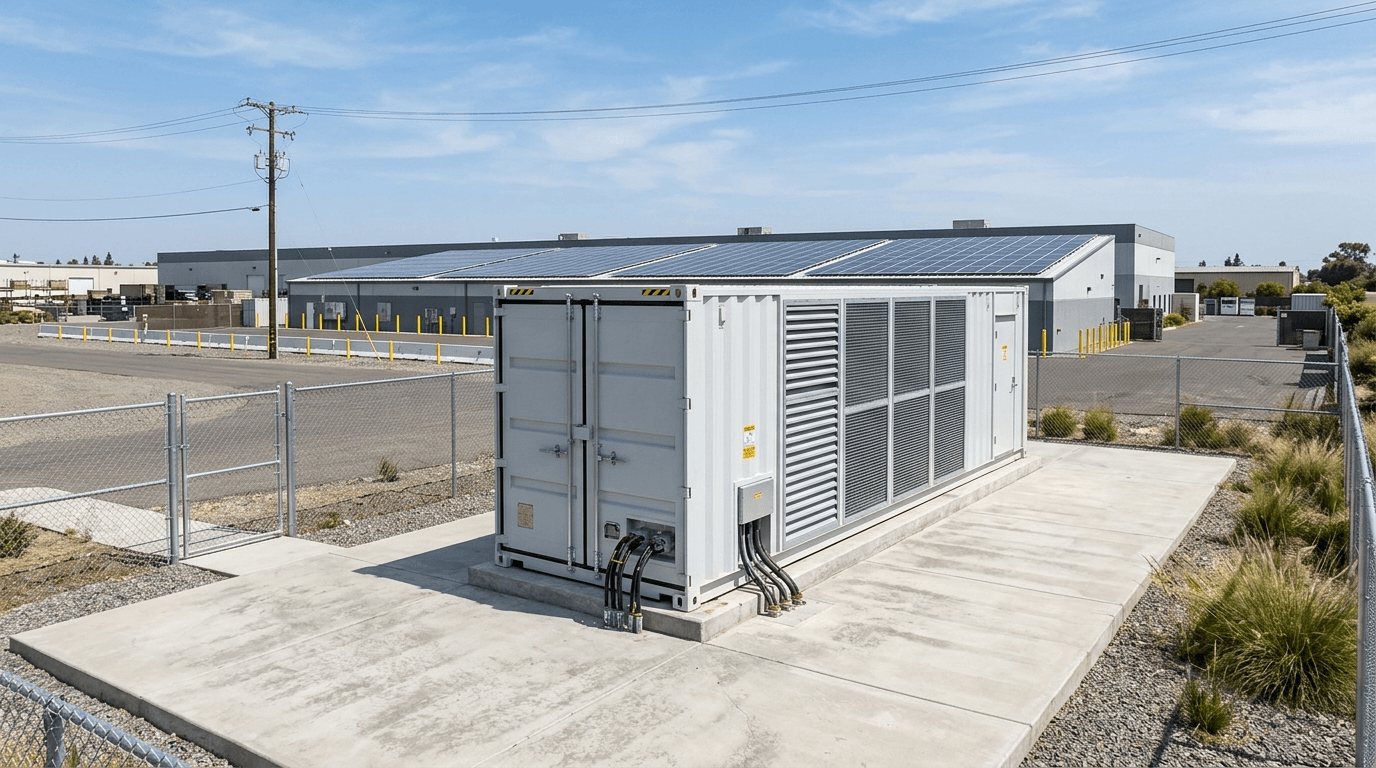
Containerised energy storage system in an industrial yard. Conceptual image.

What is an energy storage system (ESS)?

An energy storage system, or ESS (BESS when it is battery-based), is an integrated set of lithium iron phosphate (LFP) batteries, a battery management system (BMS), a bidirectional power conversion system (PCS) and an energy management system (EMS). It stores electricity when it is cheap or when solar is producing, and delivers it at peak hours, during a grid outage, or whenever it is needed.

For an industrial user in Iran, storage does three main jobs: lower peak-hour and demand charges, keep production running through power cuts, and make more use of on-site solar.

Capacity: from one cabinet to many MWh

Commercial and industrial storage is modular. The smallest block is a 261 kWh cabinet, and higher capacities come from putting those blocks, or larger containers, side by side. A project can start small and grow later.

  1. 261 kWh

    Cabinet

    One outdoor cabinet of about 125 kW, suited to workshops, commercial buildings, fuel stations and small plants.

  2. ≈ 1 MWh

    Cabinets in parallel

    Four 261 kWh cabinets together make about 1.04 MWh, with room to add cabinets later.

  3. 2–5 MWh

    Containerised

    2, 3, 4 and 5 MWh systems in a container, factory-assembled, with liquid cooling and integrated safety systems.

  4. 20+ MWh

    Large-scale plants

    Built by paralleling containers: a 20 MWh system, for example, is four 5 MWh systems.

Cabinet or container: typical specifications

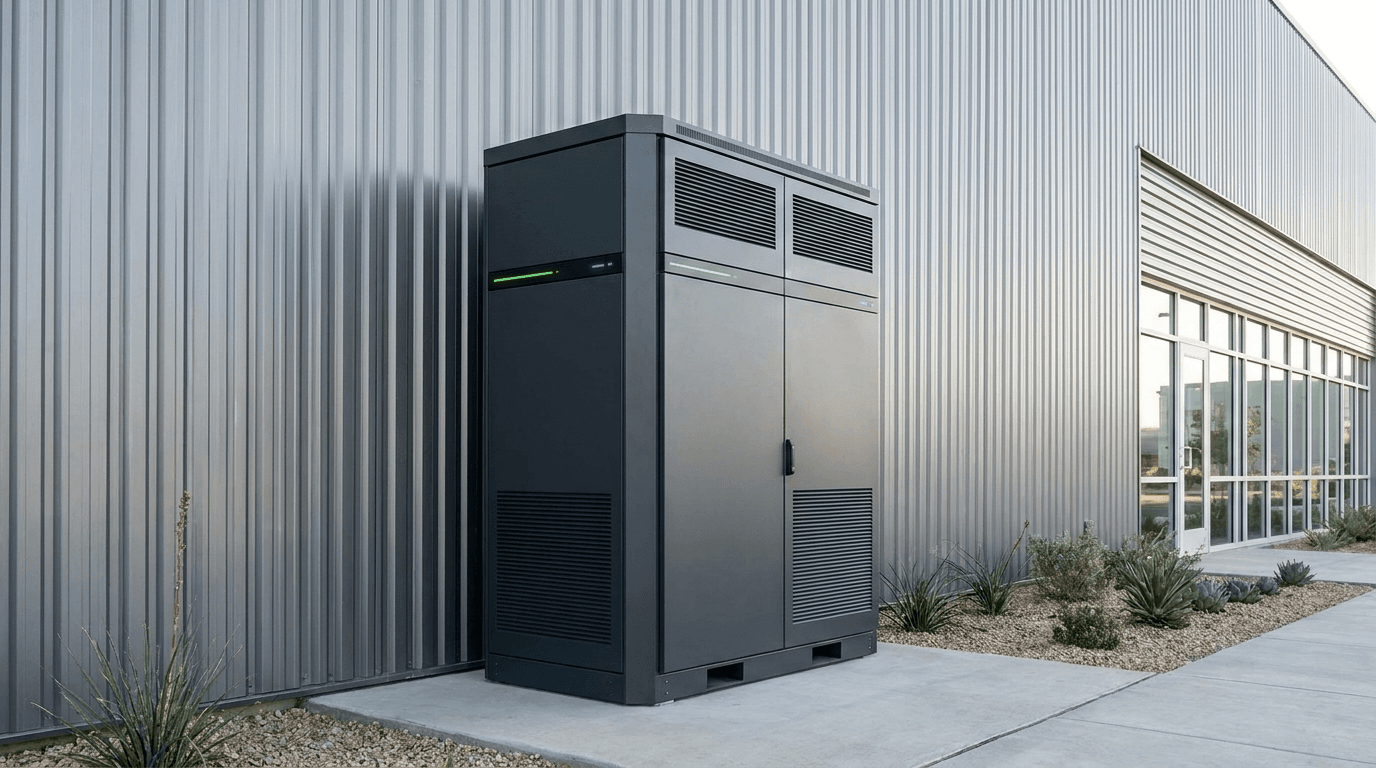
Storage cabinet beside an industrial building. Conceptual image.

Cabinet ESS

For 261 kWh up to about 2 MWh. A small footprint beside the building, and capacity grows one cabinet at a time.

Containerised energy storage system. Conceptual image.

Containerised ESS

For 2 to 5 MWh per container and plants of tens of MWh. Cost per kWh is lower at this scale and on-site installation is fast.

ParameterC&I cabinet20 ft container
Energy215 to 261 kWh3.7 to 5 MWh (newest generation up to about 6.9)
Power100 to 137 kW (about 0.5C)Set by the PCS; for 5 MWh about 1.25 MW (4 h) to 2.5 MW (2 h)
CellLFP, 3.2 V, 314 AhLFP, 3.2 V, 314 Ah
DC voltageAbout 650 to 940 VAbout 1040 to 1500 V
AC connection400 V three-phase, built-in PCSSeparate PCS and transformer to medium voltage
CoolingLiquid (cell spread about 3 °C or less)Liquid
EnclosureIP55, outdoorIP55, C4 anti-corrosion
Round-trip efficiencyAbout 90 to 91% (AC side)About 92 to 94%
Cycle life8,000 cycles or more8,000 or more; newest generation over 12,000
Size and weightAbout 1.4 × 1.0 m, about 2.3 m tall; 2.5 to 2.8 t20 ft container (6.1 × 2.4 × 2.9 m); 40 to 43 t
Fire safetyAerosol suppression, explosion vent, smoke and gas detectionFlammable-gas, smoke and heat detection, explosion vent panels, aerosol or water suppression
Operating temperature-30 to +50 °C-30 to +50 °C
StandardsIEC 62619, IEC 62477, UN38.3, UL 9540AUL 9540, UL 9540A, UL 1973, NFPA 855, IEC 62619
ScalingSeveral cabinets in parallel, up to a few MWhContainers in parallel, e.g. 4 × 5 = 20 MWh

These figures are the typical range of each equipment class, taken from leading manufacturers' datasheets. Exact specifications for each project depend on the equipment chosen and are stated in the technical proposal.

What energy storage is used for

Peak shaving

At consumption peaks part of the load is served from the battery, keeping registered demand and its charge down.

Time-of-use shifting

The battery charges on cheap night-time power and supplies the load during the expensive peak hours.

Backup through power cuts

Through scheduled or sudden grid cuts, production lines and critical loads keep running from the battery.

Solar self-consumption

Midday solar output is stored and used in the afternoon and evening, when the sun is gone.

Replacing or assisting diesel

The generator only runs when truly needed, cutting fuel, noise, maintenance and the worry of securing fuel.

Microgrids and power quality

Islanded operation, voltage and frequency support, and black start after a full outage.

What an ESS is made of

Lithium iron phosphate (LFP) battery
The common, safe chemistry for stationary storage: thermally stable, with thousands of cycles. 314 Ah cells are today's market standard.
Battery management system (BMS)
Monitors and balances cell voltage, current and temperature, and trips the system on any abnormal condition.
Power conversion system (PCS)
Converts grid AC to DC to charge, and battery DC back to AC to discharge. It sets the system's power rating.
Energy management system (EMS)
The brain: decides when to charge and discharge, coordinates with solar and diesel, and enables remote monitoring.
Liquid cooling
Keeps cell temperatures uniform, which matters for Iran's hot summers and for battery life.
Safety and fire suppression
Gas, smoke and heat detection, automatic suppression and explosion venting, following the UL 9540A and NFPA 855 approach.

How a project is delivered

  1. 1

    Feasibility and load analysis

    Bills, load profile, outage hours and the project goal: lower cost, backup, or both.

  2. 2

    Sizing and financial estimate

    Required power (kW) and energy (kWh), cabinet or container, and the payback estimate.

  3. 3

    Engineering design

    Site survey, electrical and protection design, layout, foundations and the connection to the switchboard or MV grid.

  4. 4

    Equipment supply

    Batteries, PCS, EMS and balance of plant from reputable brands, matched to the design.

  5. 5

    Installation and commissioning

    Installation and cabling, performance and protection tests, EMS setup and operator training.

  6. 6

    Monitoring and support

    Remote monitoring, periodic service and warranty handling after handover.

kW or kWh: how the right size is set

Every storage system has two numbers: power (kW), the load it can carry at any moment, and energy (kWh), how long it can keep that up. Their ratio sets the discharge duration: a 5 MWh system at 2.5 MW runs for two hours, at 1.25 MW for four.

An example: a factory wants to carry 500 kW of its load from the battery through a four-hour afternoon peak. That is 2,000 kWh of energy; allowing for depth of discharge and losses, nameplate capacity comes to about 2.2 MWh, roughly nine 261 kWh cabinets or one containerised system. The exact figure comes from the real load profile, not a guess.

Energy storage and Iran's grid

In recent summers many industrial parks and plants have faced scheduled power cuts one or more days a week, and peak-hour electricity is billed at a higher tariff. Battery storage addresses both at once: on normal days it cuts the peak cost, and on a cut day it keeps production running.

Storage is being taken seriously at grid level too: in 1405 (2026) Tavanir approved 300 MWh of battery storage at 20 points on the national grid. In the hot south, liquid cooling, shading and careful siting are built into the design so the battery stays within its rated temperature.

ESS frequently asked questions

How is an ESS different from a UPS?

A UPS is built for minutes to tens of minutes of emergency power and mostly sits idle. An ESS is built for hours of discharge and daily cycling: it lowers the bill every day and also provides backup.

What capacity does a factory need?

It depends on the load to carry and for how long. Capacity is power times hours, allowing for depth of discharge and losses: 500 kW for four hours needs about 2.2 MWh nameplate. We calculate it from your bills and load profile.

Cabinet or container?

Up to about 2 MWh, cabinets are more flexible and can grow in steps. From about 2 MWh up, a container lowers cost per kWh and footprint. Plants of tens of MWh are built by paralleling containers.

How long does an LFP storage battery last?

Today's LFP storage batteries are typically rated for 8,000 cycles or more, which at one cycle a day is over 20 years, provided they stay within their rated temperature, which liquid cooling ensures.

How is fire safety handled?

In layers: thermally stable LFP chemistry, a BMS that prevents over-charge and over-temperature, gas, smoke and heat detection, automatic suppression and explosion venting. Reputable systems are tested and designed to UL 9540A and NFPA 855.

Can an ESS be added to an existing solar plant?

Yes. Storage can be AC-coupled to an existing plant, holding midday surplus for peak hours without changing the existing inverters.

Does it work in the heat of southern Iran?

Liquid-cooled systems typically operate up to 50 °C ambient. In hot regions, shading, siting and ventilation are part of the design so the battery stays within its rated range.

How much does an energy storage system cost?

It depends on capacity, power, cabinet or container, and site conditions, and cost per kWh falls with scale. After the load analysis we provide a technical and financial proposal with a payback estimate.

Related pages

Start your energy project with us

Request Consultation
CallWhatsAppConsult